
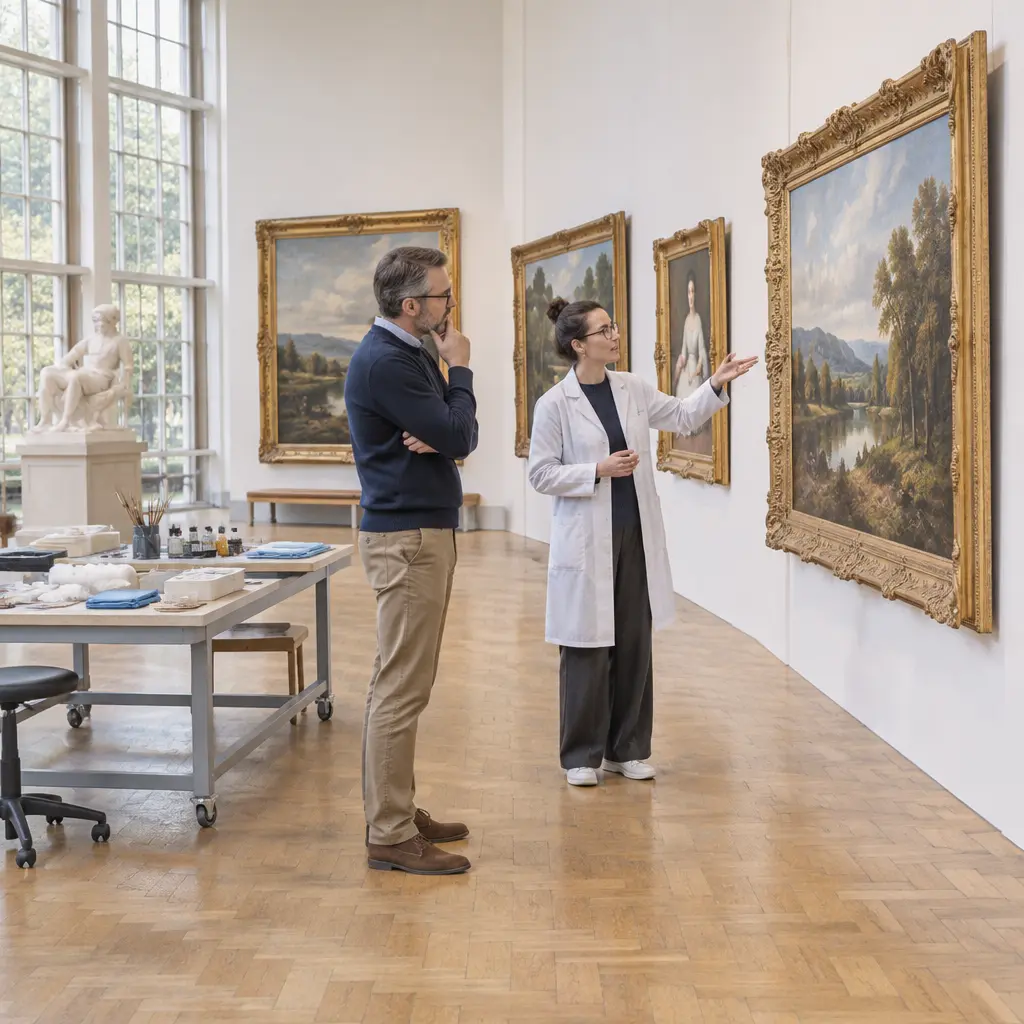
Art collecting as cultural stewardship means acquiring, caring for, and sharing artworks in ways that protect their histories and public significance—not treating them chiefly as instruments for financial gain. The distinction matters in a global art market where annual sales reached an estimated $57.5 billion in 2024, according to the Art Basel and UBS Art Market Report. Stewardship offers a different measure of value: responsible provenance research, conservation, ethical acquisition, thoughtful lending, and access for future generations. Museums, collectors, artists, and communities can all put that approach into practice.
Cultural stewardship defines art collecting beyond asset accumulation
“Cultural stewardship” is not a single legal or universally standardized term. In museum practice, however, stewardship describes the responsible care of collections held in trust for public benefit. The American Alliance of Museums’ Code of Ethics emphasizes that collections should be held, cared for, and made accessible in the public interest. Applied to private collecting, the principle is a voluntary commitment: an owner recognizes that an artwork can carry artistic, historical, spiritual, and community meaning beyond its market price.
This approach does not require collectors to ignore financial realities. It asks them not to make investment performance the overriding purpose of collecting. The market’s scale helps explain why the distinction is consequential: the Art Basel and UBS report estimated 2024 global art sales at $57.5 billion, down 12% from 2023, while sales volume rose 3% to about 40.5 million transactions. Those figures describe market activity, not cultural value; an artwork’s importance cannot be inferred from its price or resale prospects.
Stewardship has several related forms, or hyponyms: provenance stewardship, conservation stewardship, ethical acquisition, community-centered stewardship, and access-oriented stewardship. Together, they turn collecting from possession alone into a cycle of inquiry, care, accountability, and sharing.
Provenance stewardship: knowing an artwork’s history
Provenance is the documented history of an object’s ownership and custody. Provenance stewardship means investigating that history before purchase and preserving the records afterward. A careful collector reviews invoices, exhibition histories, export permits, catalogues, and gaps in ownership, and consults relevant specialists when the history is uncertain.
This work is not merely administrative. The International Council of Museums’ Code of Ethics for Museums states that institutions should not acquire objects unless they are satisfied that valid title can be obtained and that the object has not been illicitly acquired, exported, or transferred. Private collectors can adopt a similar standard. The 1970 UNESCO Convention provides an international framework for preventing and addressing the illicit import, export, and transfer of cultural property, underscoring why lawful ownership and responsible documentation matter.
Where records are incomplete, collectors should treat uncertainty as a reason for further research rather than as a minor inconvenience. For archaeological material, sacred objects, and works that may have been displaced during conflict or colonial rule, specialist advice and consultation with source communities may be essential.
Conservation stewardship: protecting material and meaning
Conservation stewardship is the long-term care of an artwork’s physical condition and contextual integrity. It includes suitable temperature and humidity, safe handling and storage, preventive pest management, appropriate framing, and consultation with trained conservators before treatment. Good care also preserves associated information: labels, artist correspondence, installation records, and conservation reports can help future researchers understand how a work was made and used.
The need is substantial. UNESCO’s 1970 Convention notes that cultural property is vulnerable to theft, clandestine excavation, and illicit export, while physical deterioration can also result from neglect or unsuitable conditions. A stewardship-minded collector budgets for care before buying, documents any intervention, and avoids restoration intended only to make a work more commercially appealing when it could compromise its authenticity or history.
Conservation also connects private ownership to public benefit. A stable, well-documented work is more likely to be safely loaned, studied, and responsibly passed on, whether to a museum, a family member, or another custodian.
Ethical acquisition connects collecting to communities and artists
Once collectors investigate an object’s history and care requirements, the next question is how it entered the market and who has a legitimate stake in it. Ethical acquisition means assessing legal title, cultural sensitivity, the circumstances of sale, and the interests of artists and communities—not simply whether a purchase is affordable or likely to appreciate.
Cultural property and repatriation
Repatriation is the return of cultural property to a person, community, or country with a compelling claim to it. It is especially relevant to human remains, sacred objects, archaeological material, and items removed under colonial or coercive conditions. Collectors should consider whether a work has been subject to a restitution claim, whether source communities have been consulted, and whether a sale could perpetuate harm even if current possession appears legally documented.
In the United States, the Native American Graves Protection and Repatriation Act (NAGPRA) establishes processes for museums and federal agencies to inventory, consult on, and repatriate Native American human remains and certain cultural items to lineal descendants, tribes, and Native Hawaiian organizations. The law’s reach and procedures have evolved, including through regulations effective in 2024. Although private collectors are not covered in exactly the same way as museums and federal agencies, NAGPRA illustrates a broader ethical principle: cultural objects can carry obligations to living communities that exceed ordinary market ownership.
Fair support for living artists
Artist-centered collecting supports the people who create the work, not only the market that resells it. Collectors can buy directly from artists or reputable galleries, pay agreed prices promptly, follow contractual terms, credit artists accurately, and seek permission for reproduction or public display where required. They can also avoid pressuring artists to make work primarily for speculative demand.
The market’s structure makes these choices meaningful. The Art Basel and UBS 2024 report found that dealer sales were concentrated among businesses of different sizes and that smaller galleries often face greater operating pressures than larger firms. Buying from emerging artists and their galleries can help sustain creative practice, but responsible support requires informed relationships rather than treating an artist’s career as a prediction of future returns.
Collectors should also distinguish resale from direct support. In the United States, the federal Visual Artists Rights Act gives qualifying creators certain rights concerning attribution and the integrity of specified works, but it does not establish a general resale royalty. Rules differ across jurisdictions, so collectors should understand applicable contracts and local law.
Access-oriented stewardship makes private collections more public
Access-oriented stewardship expands the benefits of collecting through loans, exhibitions, research, education, and eventual gifts or bequests. It does not mean every artwork must be continuously displayed. It does mean considering whether a work’s cultural significance can be made available to others while protecting the object and respecting the owner’s obligations.
Loans, interpretation, and shared authority
A responsible loan involves more than delivering an object to an exhibition. Owners and borrowing institutions should agree on handling, transport, insurance, security, environmental conditions, image rights, and credit lines. Interpretation matters, too: labels and catalogues should provide accurate context and acknowledge uncertainty rather than presenting a collector’s account as the only authoritative story.
Shared authority is especially important for Indigenous, sacred, or community-connected works. A museum or lender can consult source communities about terminology, display, photography, and whether public exhibition is appropriate at all. Stewardship may sometimes require restricted access or non-display, rather than greater visibility.
Gifts, bequests, and long-term succession
Succession planning determines who will care for a collection and under what conditions after the collector’s death or incapacity. A thoughtful plan identifies intended recipients, provides complete ownership and conservation records, clarifies any restrictions, and considers whether a museum or public institution has the capacity and mission fit to accept a gift.
A donation is not automatically a public benefit if the receiving institution cannot conserve, research, or display the work responsibly. Collectors should discuss proposed gifts with institutions early, avoid burdensome conditions, and consider whether a bequest, long-term loan, shared custody arrangement, or sale to fund conservation would better serve the work. The American Alliance of Museums’ ethical guidance stresses that collection decisions should support institutional missions and public trust.
Putting cultural stewardship into practice
Collectors can translate principle into a practical process by asking questions before, during, and after acquisition. This checklist applies to private buyers, foundations, and institutions:
- Research the artist, object, ownership history, export status, and any known restitution concerns.
- Seek qualified advice when provenance, attribution, cultural sensitivity, or condition is uncertain.
- Budget for conservation, storage, insurance, documentation, and safe transport before purchase.
- Buy through transparent channels and honor contracts, artist credits, and reproduction rights.
- Consider whether a loan, research visit, community consultation, or public programme would be appropriate.
- Create a succession plan that identifies a capable future custodian and preserves the collection’s records.
A simple collection record can make these commitments durable. For each work, document the artist and title, date and medium, dimensions, purchase details, provenance, condition, conservation history, legal documents, image permissions, and any community consultation or display restrictions. A chart comparing acquisition price with total lifetime costs—care, insurance, transport, and documentation—can also help show why stewardship is a long-term responsibility rather than a one-time transaction.
Conclusion: collecting as a responsibility across generations
Cultural stewardship reframes art collecting around the responsibilities that accompany ownership. Provenance research protects history and lawful title; conservation safeguards objects and their records; ethical acquisition recognizes artists and source communities; and access and succession planning help works remain meaningful beyond one owner’s lifetime. In a market measured in tens of billions of dollars, price is visible and easy to compare, but cultural value depends on context, care, and relationships.
Collectors can begin by reviewing the provenance and condition records for one work, consulting a conservator or relevant community where appropriate, and writing down a realistic plan for future care. The wider goal is not to reject ownership, but to practice it with accountability—so that art remains a living cultural resource rather than merely an item on a balance sheet.
Sources: Art Basel and UBS, The Art Basel and UBS Global Art Market Report 2025, https://www.artbasel.com/about/initiatives/the-art-market; American Alliance of Museums, Code of Ethics for Museums, https://www.aam-us.org/programs/ethics-standards-and-professional-practices/code-of-ethics-for-museums/; International Council of Museums, ICOM Code of Ethics for Museums, https://icom.museum/en/resources/standards-guidelines/code-of-ethics/; UNESCO, Convention on the Means of Prohibiting and Preventing the Illicit Import, Export and Transfer of Ownership of Cultural Property, 1970, https://www.unesco.org/en/legal-affairs/convention-means-prohibiting-and-preventing-illicit-import-export-and-transfer-ownership-cultural; National Park Service, Native American Graves Protection and Repatriation Act, https://www.nps.gov/subjects/nagpra/index.htm; U.S. Copyright Office, Visual Artists Rights Act of 1990, https://www.copyright.gov/title17/92chap13.html#106A.


