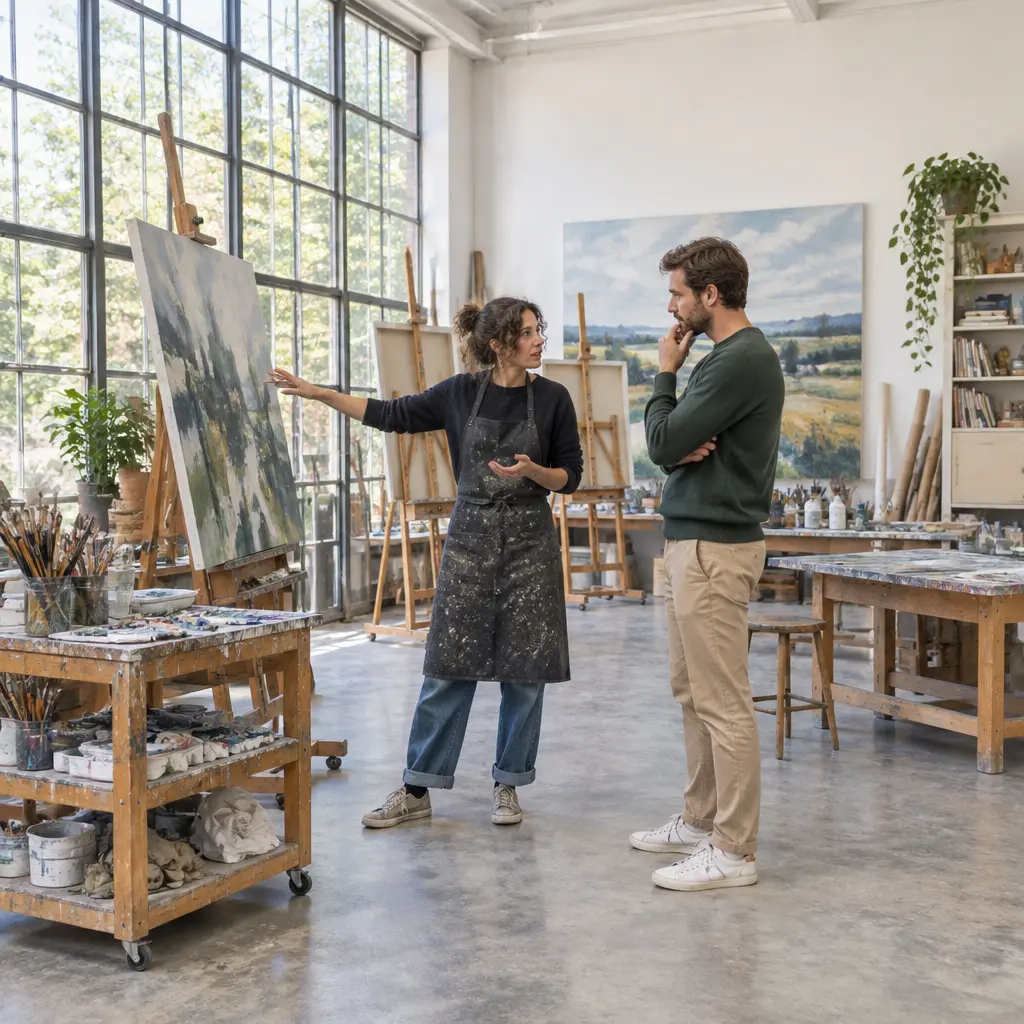
A studio visit is a planned conversation in an artist’s working space, and good studio-visit etiquette is the practice of approaching that invitation with respect, curiosity, and care. To build genuine artist relationships, confirm expectations in advance, listen before judging, ask thoughtful questions, respect boundaries and confidential information, and follow up without treating the visit as a transaction. These habits matter in a field where artists often rely on relationships and professional networks: the National Endowment for the Arts’ 2022 Survey of Public Participation in the Arts found that 48% of U.S. adults attended at least one visual-arts event in the prior year, while visits to artists’ studios are a more personal, less formal way to encounter creative work.
Studio Visit Etiquette: The Foundations of Genuine Artist Relationships
Studio-visit etiquette has no single official code. It is a practical set of social and professional behaviors that makes a visit useful and comfortable for both artist and guest. The Association of Art Museum Directors describes professional museum practice through responsibilities such as transparency, due diligence, and respect for artists and collections; applied to a studio visit, those principles mean being clear about your role, attentive to the artist’s terms, and careful with what you see and hear.
A visit may be a peer exchange, a curator’s research appointment, a collector’s introduction, a student’s learning opportunity, or a journalist’s interview. Those different purposes change what is appropriate to ask and what the artist may reasonably expect. Across all of them, the central measure is reciprocity: the guest should bring attention, preparation, and consideration rather than assuming access to the artist’s time, work, or private life.
Prepare and clarify the purpose
Preparation means agreeing on the visit’s purpose, duration, participants, and any documentation before arriving. A short message can establish whether the artist wants to discuss current work, show a particular project, or simply host an informal conversation. If you represent an institution, publication, gallery, or potential buyer, say so plainly. The artist can then decide what to share and how to prepare.
Do modest research: learn the artist’s name, pronunciation, medium, and publicly available work. Preparation should support conversation, not turn it into an examination. Avoid arriving with a hidden agenda, such as expecting a sale, an introduction, or permission to publish images that was never discussed.
Arrive on time and respect the working space
Punctuality matters because an artist’s studio is both a workplace and, sometimes, a home. If delayed, send a prompt update; if you need to cancel, give as much notice as possible. Follow the artist’s instructions about entry, footwear, refreshments, safety equipment, and where to stand. Do not touch artworks, tools, materials, or equipment unless invited. In studios with solvents, machinery, fragile work, or active installations, these rules protect people as well as art.
Ask before bringing another guest, and do not assume that a studio is a public gallery. The artist may need to keep certain areas, works in progress, or personal belongings private. When access needs or safety concerns arise, discuss them ahead of time rather than improvising at the door.
Respectful Conversation Strengthens Studio Visit Etiquette
Conversation is the heart of a studio visit, but it should not become an interrogation or a performance of expertise. The artist is the authority on their intentions and working conditions; the visitor can offer attentive observations and genuine questions without claiming to decode the work. Research on active listening, including guidance from the Center for Creative Leadership, emphasizes listening to understand, asking clarifying questions, and reflecting back what was heard. These practices are especially valuable when discussing work that is unfinished, personal, or difficult to interpret.
Ask open, specific questions
Open questions invite an artist to explain choices in their own terms. Ask, for example, “How did this material change the direction of the piece?” or “What are you testing in this series?” Specific questions show that you are looking closely, while open wording leaves room for an answer more nuanced than yes or no.
Avoid questions that presume a single correct interpretation or reduce the work to biography, identity, or market value. Questions about price, representation, or career strategy can be appropriate when relevant, but ask permission before shifting into those subjects. A pause is not necessarily an invitation to fill the silence; artists may be thinking, demonstrating a process, or simply allowing the work to be experienced.
Offer feedback with consent and care
Feedback is most useful when the artist wants it. Before offering critique, ask, “Would you like a response, or would you prefer me to listen and ask questions?” If invited, describe what you observed, explain your response, and distinguish personal taste from a claim about quality. Specific comments are more actionable than sweeping judgments: “The repeated marks draw my eye toward the edge” is more constructive than “This does not work.”
The same care applies to praise. Generic compliments can feel perfunctory, while a precise observation demonstrates engagement. If you do not understand a piece, say so respectfully and ask about the artist’s process rather than pretending expertise or dismissing the work.
Handle disagreement and sensitive subjects thoughtfully
A studio visit can involve disagreement about interpretation, representation, materials, or cultural context. Discuss the work rather than assigning motives to the artist. When a topic concerns lived experience or identity, avoid expecting the artist to educate you or speak for an entire community. The Smithsonian’s National Museum of the American Indian’s guidance on respectful engagement with Indigenous cultures is a useful reminder that cultural material carries histories and responsibilities beyond its visual appearance.
Boundaries and Confidentiality Define Responsible Studio Visits
A studio visit can expose work that has not been exhibited, private materials, or information shared in confidence. Respectful etiquette therefore includes asking before photographing, recording, posting, quoting, or forwarding anything. Copyright law generally gives creators control over reproduction of their work; seeing an artwork in person does not itself grant permission to copy or publish an image. The U.S. Copyright Office explains that copyright protection applies to original works of authorship fixed in a tangible medium, including visual artworks.
Ask before photographing or sharing
Do not assume that a phone camera is welcome. Ask whether photographs are permitted, which works may be photographed, and whether images can be shared publicly. A “yes” to taking a reference picture is not automatically permission to post it online, use it in promotional material, or reproduce it in an article. Confirm the permitted use and any required credit.
If the artist declines, accept the decision without pressing for a reason. Some works are unfinished, under embargo, or tied to contracts and exhibition plans. The same principle applies to notes and quotations: clarify whether a conversation is on the record before publishing or attributing statements.
Recognize commercial and professional boundaries
Collectors, dealers, curators, and consultants should explain their role and avoid implying opportunities that do not exist. If a purchase, exhibition, commission, or representation is under discussion, be clear about next steps, decision timelines, fees, and who has authority to decide. Do not negotiate aggressively in a setting where the artist expected a social or research visit.
When a conversation is not commercial, do not turn it into unsolicited career advice. Artists may welcome introductions or resources, but those offers should be specific, relevant, and easy to decline. Professional generosity is not measured by how many promises are made; it is measured by whether commitments are accurate and followed through.
Be attentive to access, safety, and labor
Studios differ in accessibility, ventilation, lighting, noise, and physical layout. Ask about practical needs in advance and communicate your own access requirements clearly. If the artist is demonstrating a labor-intensive process, remember that materials and setup cost money and time. Do not request a demonstration or sample as though it were effortless, and do not handle tools or materials without permission.
Follow-Up Turns a Visit into a Genuine Artist Relationship
A meaningful relationship is built through repeated, reliable interactions, not a single impressive visit. Research on social capital, including Robert Putnam’s work on networks and civic participation, describes how trust and reciprocity support durable connections. In an art context, that means treating the artist as a person and professional, not as a source of access, content, or future opportunity.
Send a considered thank-you
Within a few days, send a brief note thanking the artist for the time and naming something specific that stayed with you. If you promised to share a contact, article, or resource, include it. Avoid vague praise that could be sent to anyone; a concrete detail signals that you were attentive.
Follow through without creating pressure
If the visit led to a possible collaboration or professional decision, communicate the next step and timeline. If no opportunity is available, say so directly rather than leaving the artist waiting. Do not repeatedly message for updates, request additional unpaid labor, or interpret a warm conversation as consent to ongoing access.
Stay in touch in ways that fit the relationship: attend a public exhibition, share a relevant opportunity, or respond thoughtfully to work the artist has chosen to make public. Genuine connection does not require constant contact. It requires consistency, respect, and mutual interest.
A practical visit checklist
- Confirm the purpose, time, length, attendees, and any access needs.
- Research the artist’s public work and be transparent about your role.
- Arrive on time, follow studio instructions, and ask before touching anything.
- Listen closely, ask open questions, and seek consent before giving critique.
- Ask before photographing, recording, quoting, or sharing information.
- Send a specific thank-you and complete any promised follow-up.
Conclusion: Make Studio Visit Etiquette a Practice of Reciprocity
Studio visit etiquette begins with preparation, continues through attentive and respectful conversation, and extends to confidentiality, clear professional boundaries, and thoughtful follow-up. These practices help artists retain control over their work and working space while allowing guests to learn, connect, and contribute appropriately. Before your next visit, clarify your purpose, ask permission where needed, and make only commitments you can keep. For further guidance, consult the cited arts organizations’ professional and cultural-engagement resources, as well as the U.S. Copyright Office’s information on visual-art rights.
Sources: National Endowment for the Arts, 2022 Survey of Public Participation in the Arts, https://www.arts.gov/impact/research/publications/2022-survey-public-participation-arts; Association of Art Museum Directors, Professional Practices in Art Museums, https://www.aamd.org/standards-and-practices; Center for Creative Leadership, Active Listening, https://www.ccl.org/articles/leading-effectively-articles/coaching-others-use-active-listening-skills/; Smithsonian National Museum of the American Indian, Guidelines for Collaboration, https://americanindian.si.edu/nk360/informational/colloquium; U.S. Copyright Office, Copyright Registration of Visual Arts, https://www.copyright.gov/registration/visual-arts/; Putnam, Robert D., Bowling Alone: The Collapse and Revival of American Community, Simon & Schuster, 2000.