An art gallery exhibition is a planned presentation of artworks in a space, shaped by curatorial choices and made possible through research, budgeting, conservation, design, installation, and public programming. Planning starts with a concept and a feasible checklist of works; installation then turns that plan into a safe, accessible environment where visitors can encounter the art. The process matters because galleries must balance interpretation, physical care, visitor access, and operational limits: the American Alliance of Museums’ 2022 National Museum Survey reported that 97% of responding museums had reopened to the public, while attendance and staffing continued to recover unevenly after the pandemic. The sections below explain exhibition planning, artwork selection and interpretation, logistics and conservation, installation, and evaluation.
Planning Defines the Art Gallery Exhibition Concept
Exhibition planning is the process of defining a visitor-facing idea and coordinating the resources, people, objects, and space needed to present it. The American Alliance of Museums describes museum work as a coordinated practice involving collections, interpretation, operations, and public service; an exhibition is one place where those responsibilities meet. A clear concept provides the test for later decisions: whether a work belongs, what visitors should learn or experience, and what the institution can responsibly deliver.
Common exhibition types include collection displays, thematic group exhibitions, solo presentations, historical surveys, touring exhibitions, and site-specific projects. They differ in the source of artworks, research requirements, loan arrangements, and design constraints, but all require a defined scope, schedule, budget, and audience.
Concept, audience, and objectives
A concept is the central question, argument, or experience that organizes the exhibition. Curators translate it into practical objectives—for example, introducing an artist, comparing artistic approaches, or inviting visitors to consider a historical issue. Audience research helps the team determine what background visitors may bring and what forms of interpretation may help them engage. These objectives should be specific enough to guide selection and evaluation rather than simply describe a broad subject.
Schedule, budget, and project team
An exhibition schedule works backward from the opening date, allowing time for research, approvals, loans, fabrication, shipping, installation, and testing. The budget typically accounts for staff time, insurance, transport, crating, conservation, design, graphics, construction, accessibility, marketing, and public events. The project team may include a curator, registrar, conservator, designer, preparator, educator, communications staff, and facilities personnel. The Canadian Conservation Institute’s preventive conservation guidance emphasizes that environmental conditions, handling, security, and emergency planning should be considered as part of routine collection care, not added as last-minute fixes.
Once the concept and resources are aligned, the team can decide which objects can tell the story and whether they can be borrowed, transported, and displayed safely.
Artwork Selection Shapes the Art Gallery Exhibition Narrative
Artwork selection is the curatorial process of identifying and securing objects that support the exhibition’s purpose while meeting scholarly, legal, physical, and practical requirements. The International Council of Museums’ Code of Ethics for Museums calls for professional diligence in acquisition, documentation, provenance, and care. In exhibition planning, this means that an object’s interpretive value must be weighed alongside its condition, ownership, availability, and display needs.
Research, provenance, and rights
Research establishes what an artwork is, how it relates to the exhibition’s argument, and what can responsibly be said about it. Provenance research traces an object’s ownership history and can reveal gaps, disputed claims, or cultural property concerns. The team also confirms reproduction permissions, credit lines, lender conditions, and any restrictions on photography or publication. These checks are especially important for works with complex histories or culturally sensitive material.
Loans, condition, and feasibility
A loan is a temporary transfer of an artwork for exhibition, usually governed by a written agreement that specifies dates, handling, environmental conditions, security, insurance, and transport. Registrars coordinate loan requests and documentation, while conservators assess condition and recommend display limits. A work may be conceptually ideal yet unsuitable if its fragility, size, value, or lender requirements exceed the gallery’s capabilities. For borrowed objects, a facility report can help lenders assess the venue’s security, climate control, and emergency preparedness.
Selection becomes meaningful to visitors only when the exhibition’s research is translated into an understandable route, labels, and other forms of interpretation.
Interpretation Connects the Art Gallery Exhibition to Visitors
Exhibition interpretation is the communication of context and meaning through the arrangement of objects, written materials, audio, digital resources, and staff-led experiences. The Smithsonian’s accessibility guidance advocates planning for diverse visitors and offering information in more than one way. Interpretation should support the exhibition’s central idea without assuming that every visitor has the same prior knowledge, language, sensory access, or preferred way of learning.
Narrative sequence and spatial flow
A narrative sequence is the order in which visitors encounter artworks and supporting information. A chronological route may clarify historical change; a thematic arrangement may invite comparison; and an open layout may encourage self-directed exploration. Designers and curators use plans, elevations, and mock-ups to test sightlines, circulation, resting points, and potential congestion before installation. A floor plan can be presented as a simple diagram in an exhibition proposal, showing object locations, visitor routes, entrances, and accessible turning space.
Labels, accessibility, and inclusive interpretation
Labels identify and interpret artworks, typically combining concise factual information with context or a prompt for looking. Plain language, legible type, sufficient contrast, and consistent placement can make them easier to use. Accessible interpretation may also include large-print materials, audio description, captioning, tactile resources where appropriate, seating, and clear wayfinding. The U.S. Department of Justice’s 2010 ADA Standards for Accessible Design establish requirements for accessible routes and other elements in covered facilities; exhibition teams should consult applicable standards and local codes during design rather than after construction.
With the visitor journey established, the team can convert the design into a physical installation while protecting artworks and maintaining safe working conditions.
Installation Makes the Art Gallery Exhibition Physically Real
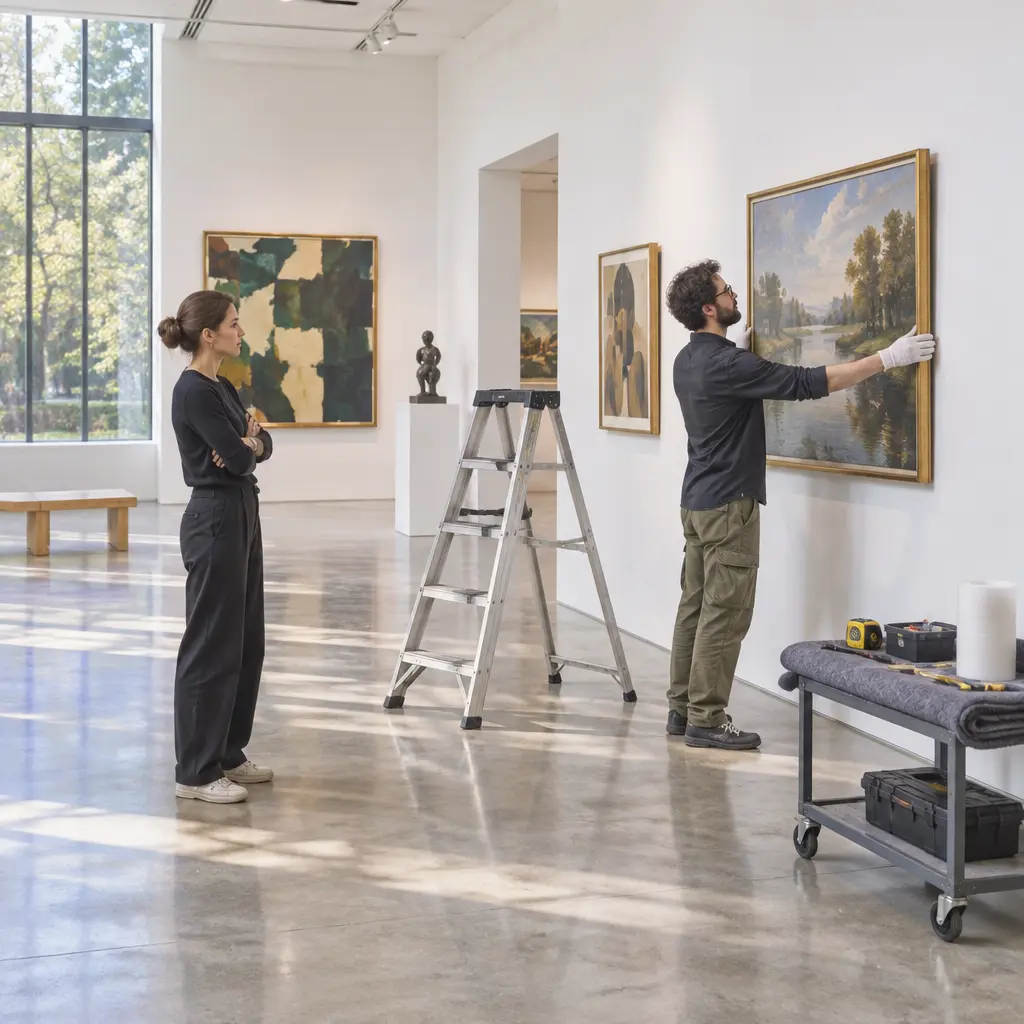
Exhibition installation is the controlled process of preparing a gallery, moving and mounting artworks, placing interpretive materials, and checking the finished environment before opening. It is coordinated by preparators and registrars in consultation with conservators, designers, and facilities staff. Installation is not merely decoration: it involves documented handling, secure mounting, appropriate environmental conditions, and compliance with fire, building, and accessibility requirements.
Gallery preparation and safe handling
Before objects arrive, staff may paint walls, complete construction, test lighting, confirm security, and mark object positions. Artworks are unpacked and inspected according to the lender’s instructions, with condition reports recording their state before and after display. Staff use suitable handling methods and supports, and may acclimatize objects to the gallery environment when required. The Canadian Conservation Institute notes that light can cause cumulative and irreversible damage to sensitive materials, so illumination levels and exposure duration should be set according to object sensitivity and conservation advice.
Mounting, lighting, and environmental controls
Mounting systems must support an object securely without damaging it or creating hazards for visitors. Lighting is designed to reveal form and color while controlling heat, glare, and damaging exposure. Temperature and relative humidity targets depend on the materials, lender requirements, and building capabilities; there is no single setting that suits every artwork. Conservators and facilities staff therefore monitor conditions and address risks such as vibration, pests, water leaks, and excessive light. The American Institute for Conservation’s professional guidance likewise treats preventive care as a continuing responsibility throughout display and handling.
Installation checks and opening readiness
A pre-opening inspection checks that objects are secure, labels are accurate, routes are clear, lighting works, and emergency and security procedures remain effective. Teams may review the gallery from a visitor’s perspective, checking sightlines, seating, readability, and whether digital components function. Any discrepancy between the approved plan and the installed exhibition should be documented and resolved before visitors enter.
Evaluation Improves the Art Gallery Exhibition Process
Exhibition evaluation is the collection and use of evidence about how a presentation performed and how visitors experienced it. Measures may include attendance, participation in programs, visitor comments, accessibility feedback, media coverage, and staff observations. The American Alliance of Museums’ National Museum Survey provides sector-level context for attendance and operating conditions, but each gallery needs local evidence to assess whether its own objectives were met.
Visitor feedback and operational review
Short surveys, interviews, comment cards, and observation can reveal whether visitors understood the exhibition’s main idea, found the space comfortable, and could access its content. Operational review considers whether the schedule and budget were realistic, whether loans and shipping went smoothly, and whether conservation or safety issues arose. Findings can inform future label writing, layout decisions, staff training, and project timelines.
A documented cycle of care
At closing, staff follow lender agreements and conservation procedures to deinstall, condition-check, pack, and return works. The team archives plans, reports, rights information, and evaluation results so that knowledge is not lost when the exhibition ends. For touring or recurring exhibitions, this documentation also helps future venues understand installation requirements and object-specific risks.
Conclusion: Planning and Installation Work as One System
A successful art gallery exhibition grows from a clear concept, responsible artwork selection, accessible interpretation, careful installation, and honest evaluation. These stages are connected: curatorial choices shape the design, design affects conservation and visitor flow, and visitor feedback can improve future planning. Galleries preparing an exhibition can start by defining its purpose, building a cross-functional team, documenting risks and requirements, and testing the visitor experience before opening. For further guidance, consult professional museum, conservation, and accessibility standards early in the project rather than treating them as final-stage checks.
Sources: American Alliance of Museums, National Museum Survey, 2022, https://www.aam-us.org/programs/about-museums/national-museum-survey/; International Council of Museums, ICOM Code of Ethics for Museums, https://icom.museum/en/resources/standards-guidelines/code-of-ethics/; Canadian Conservation Institute, Preventive Conservation Guidelines for Collections, https://www.canada.ca/en/conservation-institute/services/preventive-conservation/guidelines-collections.html; Smithsonian Institution, Smithsonian Guidelines for Accessible Exhibition Design, https://access.si.edu/sites/default/files/accessible-exhibition-design.pdf; U.S. Department of Justice, 2010 ADA Standards for Accessible Design, https://www.ada.gov/law-and-regs/design-standards/2010-stds/; American Institute for Conservation, Code of Ethics and Guidelines for Practice, https://www.culturalheritage.org/about-conservation/code-of-ethics