
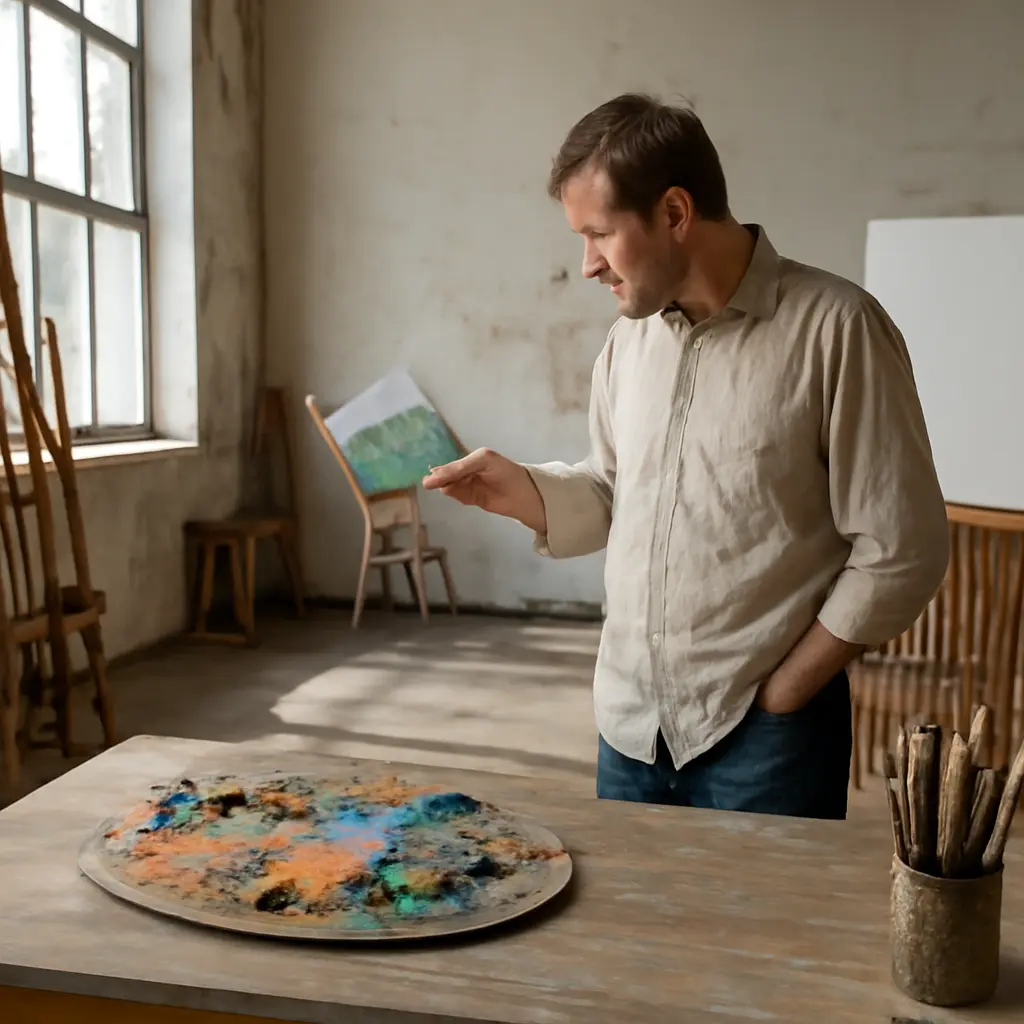
Working painters study visual problems, materials, and the conditions that shape what they see—not just the steps in a tutorial. Their practice often combines sustained observation, drawing, color mixing, compositional decisions, and experiments with light and paint. That approach has deep roots: the National Gallery of Art’s account of Leonardo da Vinci’s notebooks describes a lifelong habit of recording observations and testing ideas, while contemporary artist-teachers such as painter and educator James Gurney emphasize studying real light and color. These methods matter because painting requires choices that tutorials can demonstrate but cannot make for every subject. Below, we look at what painters study, how they structure practice, and how to use references and demonstrations without becoming dependent on them.
Working painters study visual problems through direct observation
A useful definition of working-painter study is deliberate practice aimed at understanding how a subject appears and how to translate that appearance into paint. It is not simply making more pictures: the painter selects a problem—such as value, edge, proportion, or color temperature—and tests ways to solve it. In Drawing on the Right Side of the Brain, art educator Betty Edwards describes drawing as learning to perceive relationships rather than relying on familiar symbols. Painters apply a similar principle when they compare what they actually see with what they expect a tree, face, or shadow to look like.
This kind of study has several connected forms: drawing from life, value analysis, color observation, composition studies, and material experiments. Tutorials can introduce a technique, but these studies build the judgment needed to adapt that technique to a different subject, scale, or lighting condition.
Drawing trains painters to compare relationships
Drawing is a way to test proportion, angle, shape, and spatial relationships before or during painting. Instead of drawing an “eye” as a symbol, a painter measures the width of the eye against the distance between the eyes, the angle of the brow, and the shape of the surrounding shadow. The same method works for landscapes: compare the tilt of a roofline, the height of a horizon, or the spacing between tree masses.
The practical value is diagnostic. A small thumbnail or block-in can reveal a structural mistake before the painter spends time refining details. Edwards’s approach is one well-known example of training perception through measurement and comparison; the broader lesson is to draw what is present, not what memory says ought to be present.
Value study clarifies the light-and-dark structure
Value is the relative lightness or darkness of a color. Painters study value by reducing a subject to a few broad groups, often in a grayscale sketch or a limited-palette painting. This helps establish whether the image reads clearly before color and detail complicate it. A portrait, for instance, may depend on the relationship between the lit forehead, the shadowed cheek, and the background more than on tiny features.
A simple validation exercise is to squint at the subject or reference. Squinting blurs small details and makes larger value masses easier to compare. Painters also make small black-and-white thumbnails to check whether the focal area stands apart. These are studio tools rather than universal rules: the painter chooses the number of value groups according to the subject and the desired effect.
Edge study teaches control of focus and form
An edge is the boundary between two shapes or value areas. It may be sharp, soft, lost, or broken. Studying edges helps painters describe form and direct attention: a crisp edge can make a feature feel distinct, while a soft transition can suggest atmosphere, turning form, or distance. Painters therefore ask not only what color an object is, but also where its boundary is clear and where it dissolves into neighboring shapes.
This is one reason copying a demonstration exactly can be limiting. A tutorial may show a particular edge treatment suited to its subject, but a painter working from a different scene must decide which boundaries deserve emphasis. An edge map—a quick sketch that marks hard, soft, and lost transitions—can make that decision visible before the final pass.
Working painters study color as relationships, not labels
Color study means observing how hue, value, and chroma interact under specific conditions. The Munsell color system organizes color through three dimensions: hue, value, and chroma. That framework is useful because “green” or “warm” alone does not describe a paint mixture precisely. A green can be lighter or darker, more or less saturated, and shifted toward yellow or blue.
Painters also study color in context. A gray beside orange may appear cooler than the same gray beside blue; a shadow may look purple in one setting and greenish in another. The relevant question is often not “What is the object’s color?” but “What color relationship will make this passage convincing beside its neighbors?”
Color mixing develops a practical palette vocabulary
Color mixing is the repeated testing of pigments to understand their behavior and the range a palette can produce. Painters make mixing charts, compare mixtures against a subject, and note which pigments create clean mixtures, muted mixtures, or unexpected shifts. A chart can show, for example, how one blue behaves when mixed with several yellows, or how adding a complementary color lowers a mixture’s intensity.
The process is more useful than memorizing a universal recipe because pigment names and properties vary by manufacturer and medium. James Gurney’s Color and Light discusses color through observed effects and practical painting problems, including reflected light and illumination. Painters can use such explanations as hypotheses, then verify them against their own materials and references.
Light study separates local color from illumination
Local color is the color associated with an object under ordinary viewing conditions; apparent color is the color the painter sees under a particular light, surrounded by particular colors. A white cup in warm sunlight may show warm highlights and cooler shadows, while the same cup under a blue sky can reflect cool light. Studying the lighting condition helps painters avoid treating every object as if it had a fixed, isolated color.
A practical exercise is to paint the same simple object under two lighting conditions, keeping the object and viewpoint constant. The comparison makes the influence of light easier to notice. Gurney’s discussions of outdoor light and color provide a reference point, while direct observation helps painters test how those principles apply to a particular scene.
Working painters study composition and visual hierarchy
Composition is the arrangement of shapes, values, colors, and edges within the picture. Painters study it to decide what the viewer notices first, how attention moves, and whether the image feels balanced or intentionally unsettled. Composition is not a decorative step added after the subject is painted; it affects what is included, omitted, enlarged, simplified, or moved.
The painter and teacher Edgar Payne, in Composition of Outdoor Painting, analyzed recurring arrangements of forms in landscape painting. His book is a historical example of artists studying structure rather than relying only on inspiration. Such compositional patterns are best treated as tools for analysis, not formulas that every painting must follow.
Thumbnail sketches test the big design quickly
A thumbnail is a small, simplified sketch used to test a composition before committing to a larger painting. Its scale discourages detail and makes major divisions easier to judge. Painters may try several versions, changing the horizon, focal point, or distribution of dark shapes to see which arrangement communicates most clearly.
A useful thumbnail can be made in minutes and may use only three or four value groups. Comparing multiple versions is more informative than polishing the first idea: it turns composition into a set of choices that can be evaluated rather than a single arrangement accepted by default.
Reference analysis distinguishes observation from imitation
Reference analysis means extracting useful information from a photograph, painting, or live subject without copying every feature. A painter can identify the reference’s largest value shapes, color temperature shifts, focal edges, and perspective cues, then decide which to preserve or change. This is different from tracing or reproducing an image without understanding why its parts work together.
Photographs are especially useful for recording fleeting subjects, but they flatten depth and can alter color and contrast. Comparing a photograph with direct observation—or making several studies from different references—helps reveal what the camera has simplified. The National Gallery of Art’s educational materials on looking closely at artworks likewise model the value of describing visible evidence before drawing conclusions about it.
Working painters study materials and the behavior of paint
Materials study is learning how pigments, binders, supports, tools, and application methods affect a painting’s appearance and durability. Oil, acrylic, watercolor, and gouache do not behave identically: they differ in drying, opacity, layering, and reactivation. The Smithsonian Museum Conservation Institute explains that conservation depends on understanding the materials and processes present in an artwork, a reminder that material choices have consequences beyond immediate appearance.
For working painters, this knowledge supports practical decisions: whether to work thinly or thickly, how long to wait between layers, which support suits a method, and how to avoid unwanted surface effects. Small tests on a prepared scrap or practice panel can answer these questions more safely than experimentation on a nearly finished painting.
Paint handling studies the mark as a physical event
Paint handling is the control of the amount, thickness, direction, and texture of paint. A painter studies how a brush or knife deposits a mark, how much the underlying layer shows through, and how the surface changes when the paint is dragged, dabbed, scumbled, or blended. These marks can describe texture, but they also contribute to rhythm and emphasis.
A useful exercise is to make a page of swatches using one color and several tools or consistencies. Label the results and compare which marks remain legible at a distance. This turns an intuitive process into a repeatable material experiment.
Layering and drying behavior shape the workflow
Layering is the sequence in which paint is applied, allowed to dry, modified, or covered. The right sequence depends on the medium and the intended effect. Watercolor commonly uses transparent layers that allow earlier passages to remain visible; oil painters may use a range of direct or layered approaches; acrylic can dry quickly enough to support rapid overpainting but may require different timing from oil.
Because products differ, painters should follow manufacturer guidance for safe use and test unfamiliar combinations. A small sample panel can reveal whether a glaze, varnish, or medium produces the desired surface. Conservation research also underscores why careful records of materials and methods can be valuable when a work needs later assessment or repair.
Working painters turn study into a repeatable practice
A study becomes productive when it answers a question and informs the next painting. Rather than measuring practice only by hours or finished canvases, painters can track the problem studied, the experiment attempted, and what changed as a result. This approach connects observation, analysis, and making: each finished work can generate the next set of questions.
Focused studies isolate one problem at a time
A focused study limits the number of variables so that one skill becomes easier to evaluate. A painter might make a ten-minute value sketch, a small color study of a single object, or a series of edge studies from a portrait. The aim is not to make a miniature masterpiece; it is to understand one aspect of the subject well enough to use that knowledge later.
A simple record can include the question, the conditions, the result, and one next step. For example: “Does the shadow stay cooler than the lit side in this room? Test with a limited palette; compare the mixtures; repeat outdoors.” This makes practice cumulative rather than a collection of disconnected exercises.
Copying masterworks can be useful when it has a purpose
Copying is not inherently unhelpful. A deliberate copy can reveal how an artist organized values, simplified forms, or handled paint. The key difference is whether the painter investigates a specific decision or merely reproduces the visible result. A study might isolate the value structure of a Rembrandt portrait or the color relationships in a landscape, without pretending that the copy is an original work.
When studying another artist, painters should identify the source and keep the exercise clearly distinguished from their own work. Comparing the copy with the original can prompt questions about process, but the next step is to apply the observation to a new subject. That transfer is what makes the study useful.
Tutorials work best as demonstrations, not prescriptions
A tutorial is a demonstration of one artist’s choices under particular conditions. It can explain a technique, tool, or sequence, but it cannot account for every viewer’s materials, subject, or intention. Painters can learn actively by pausing before each step, predicting what the demonstration will do, then comparing that prediction with the result.
After watching, repeat the underlying problem with a different subject or palette. If the lesson concerns soft transitions, practice them on a new form; if it concerns underpainting, test the approach on a small panel. This turns passive viewing into a transferable skill and makes it easier to recognize when a tutorial’s method is unsuitable.
Conclusion: Study builds judgment beyond the tutorial
Working painters study relationships: proportions through drawing, light through value and color, focus through edges, and meaning through composition. They also test how paint and supports behave, then use focused exercises to turn observations into reliable decisions. Tutorials, masterwork copies, and reference images can all contribute, but they are most valuable when painters ask what each example teaches and then test that lesson independently.
To begin, choose one subject and one question—such as how its shadow changes color or which edges attract attention. Make a small study, record what you notice, and apply the finding to a new painting. That cycle of seeing, testing, and revising is a more durable foundation than copying steps without understanding them.
Sources: National Gallery of Art, Leonardo da Vinci: Drawings and Notebooks, https://www.nga.gov/artists/1338-leonardo-da-vinci; Betty Edwards, Drawing on the Right Side of the Brain, https://www.penguinrandomhouse.com/books/160408/drawing-on-the-right-side-of-the-brain-by-betty-edwards/; James Gurney, Color and Light: A Guide for the Realist Painter, https://gurneyjourney.blogspot.com/p/book-color-and-light.html; Munsell Color, Understanding the Munsell Color System, https://munsell.com/about-munsell-color/how-color-notation-works/; Edgar Payne, Composition of Outdoor Painting, https://archive.org/details/compositionofout00payn; Smithsonian Museum Conservation Institute, Museum Conservation Institute, https://mci.si.edu/


